Copyright © 2010 BeNotForgot.com. All rights reserved.

Search the Journal

Friday, November 23, 2001

KINSHIP CHART


The table below shows the known familial connection(s) between the named individual and . . . James Madison Hall, the Keeper of the Journal . . . as well as to the Keeper of this family history blog . . .


IN THE JOURNAL
REAL NAME
BORN
LINK TO J.M. HALL (b. 1819)
LINK TO BENOTFORGOT
FATHERJoshua James Hall1790father2nd husband of widowed 3rd-great-grandma
FAWN

aka


PET
Florence Mahala Christian Worley? Robinson? Lambert? nee Hall1860daughter1st cousin 3 times removed
FRANKFrank Stewart1839employee & 2nd husband of the little woman2nd husband of widowed 2nd great-grand-aunt
JIMMYJames Wrigley Hall1862son1st cousin 3 times removed
JOSEPHINEJosephine Martha Hall1863daughter1st cousin 3 times removed
MAJORJames Hall Sharp1863nephewgreat grand uncle
MOTHERMahala Lee Sharp Hall nee Roberts1816stepmother & mother-in-law3rd great-grandma
MRS. BEALEElizabeth Lemaire Beale nee Waring1824mother-in-law of stepbrother3rd great-grandma
NELLIE
aka
ALEX
Mary Alexandrien Sharp nee Lemaire1843wife of step-brother2nd great-grandma
ROBERTA
aka
BERTA
aka
BURT
Roberta Downes Halyard nee Hall1852half-sister to him as well as to his wife2nd great-grand-aunt
SAMSamuel Houston Sharp1839step-brother & brother-in-law & employee2nd great-grandpa
THE LITTLE WOMANMargaret Annot Hall Stewart nee Sharp1840step-sister & wife2nd great-grand-aunt
TOBYHorace Oscar Hall1854half-brother to him as well as to his wife2nd great-grand-uncle

Thursday, June 7, 2001

Major Eugene Bolling


Eugene Bolling, Confederate officer, was born in 1832 in Tennessee to Yelverton de Mallet Bolling and Sophia Sully of South Carolina. The family relocated to Montgomery, Montgomery County, Alabama, in 1850. Bolling married Carolina E. Gayle in 1853, then moved from Edgefield County, South Carolina, to settle in Galveston County, Texas. He worked as a farmer prior to the Civil War.

Bolling's service record indicates that he enlisted on June 7, 1861, with a rank of captain.

On June 30, 1862, his company and twelve others were mustered into Confederate service at Brenham, Texas, in Washington County. Bolling held the rank of captain in Company G of Nichol's Ninth Regiment but soon commanded Company A of the First Battalion of the First Texas Infantry, known as Waul's Texas Legion.

On May 17, 1863, Waul's Legion was ordered into the confines of Vicksburg and assigned to Maj. Gen. Carter L. Stevenson's division. Captain Bolling was slightly injured during the defense of the city and sometime after was promoted to the rank of major in command of the First Battalion of Waul's Legion following the death of Maj. A. Cameron.

On July 4, 1863, Bolling and his unit surrendered to Union forces at Vicksburg and were paroled on July 5, 1863. Following parole the members of Waul's Texas Legion were returned to Texas where they were reorganized. Bolling then applied to be relieved from field duty for the remainder of the war as a result of a surgeon's opinion that a heart condition affected his service. Bolling's request was granted, and for the remainder of the war he served as major of companies F and S of Timmons's Regiment in the confines of Texas.

He surrendered on June 2, 1865, with the other soldiers under the command of Gen. Edmund Kirby Smith.

After the war Eugene Bolling married Mary Bolling, who survived him in Galveston County and later moved to Grayson County. In 1866 he served as a director of the National Bank of Texas in Galveston. The last known location of Eugene S. Bolling was in Galveston County in 1869. [SIC] According to his findagrave memorial page, he died 02 August 1870 in Cross Keys, Alabama.

BIBLIOGRAPHY: Compiled Service Records of Confederate Soldiers Who Served in Organizations From the State of Texas, NARA microfilm series M323, roll 263, National Archives, Washington D.C. Robert A. Hasskarl and Leif R. Hasskarl, Waul's Texas Legion, 1862–1865 (Ada, Oklahoma: Robert A. Hasskarl, 1985). L.L. Knight, comp., Their Last Full Measure: Texas Confederate Casualty Lists, Volume II, 1863 (Arlington, Texas: G.T.T. Publishing, 1997). Stewart Sifakis, Compendium of the Confederate Armies. Texas (New York: Facts on File, 1995). Laura Simmons, "Waul's Legion From Texas to Mississippi," Texana, VII (Spring 1969). Brett J. Derbes

The following, adapted from the Chicago Manual of Style, 15th edition, is the preferred citation for this article.

Brett J. Derbes, "BOLLING, EUGENE S.," Handbook of Texas Online (http://www.tshaonline.org/handbook/online/articles/fbobd), accessed May 08, 2012. Published by the Texas State Historical Association.


Saturday, May 12, 2001

Sunday, May 12th, 1861


To day the steamer Alamo, Capt. McKee came up and was detained here some time on account of the rail road hands failing or refusing to open the draw in the bridge. after a couple of hours detention she was enabled to pass through. weather changable in the day and a hard storm & rain throughout the night.

Monday, September 14, 1992

1866 :: Crawford House


Dallas Herald. (Dallas, Tex.), Vol. 14, No. 52, Ed. 1 Saturday, September 14, 1867

Among the victims of the yellow fever at Galveston, we find the name of Mrs. N.B. Crawford, of whom the Telegraph gives the following notice:

“She was born in Knox county, Tennessee, in the year 1815; the wife of Dr. J.W. Crawford, who died in Washington county, Texas, in the year of 1856; the daughter of Major Jesse Bartlett and Frances Calloway, who emigrated to Texas in an early day. Major Jesse Bartlett was one among the first Texians to resist Mexican oppression, and served as an officer in the army under Gen. Sam Houston during the struggle for Texas Independence. Mrs. Crawford was one of the oldest Texians in the State, and resided the largest portion of her life in Washington county, Texas. Some years previous to the war, she moved to Hempstead, where she remained until the close of the war, and then removed to Galveston where, up to her death, she kept the Crawford House. She leaves a son and daughter and many relations and friends to mourn her sore loss. Thus so untimely the community has lost one of its most benevolent servants, Christianity one of the most consistent Christians, and a family a devoted mother."


"Opposite Catholic Church, fronting on Church St."


Sunday, November 3, 1991

Mahala Lee Sharp Hall nee Roberts


175 years ago today . . . on the 3rd day of November . . . in the year 1816 . . . a baby girl is born in Washington Parish, Louisana . . . she is given the name Mahala Lee Roberts . . .


. . . Mahala Lee Sharp Hall nee Roberts . . . aka (in this Journal) Mrs. Hall . . . or Mrs. J.J. Hall . . . or Mother . . . is a 3rd great-grandma of the Keeper of this Blog (aka Vickie Everhart) . . . and is the step-mother . . . as well as the mother-in-law . . . of the Keeper of this Journal (aka James Madison Hall) . . .


Our Mahala is 43 years of age when she is first mentioned in the Journal . . . on Monday, January 16th, 1860 . . . when J.M. Hall writes that . . . Mrs. J.J. Hall also left on a visit to Mrs. Matthews with a view of purchasing a negro man for me . . .


Mahala Lee Roberts
North American Indian name meaning /"Woman"/
Mahaley /HALL/
Michala /Roberts/

  • Born on 3 November 1816 - Washington Parish, Louisiana
  • Died on 27 June 1885 - Elkhart Creek, Houston County, Texas
  • Age at death: 68 years old
  • Buried in June 1885 - Hall Cemetery, Houston County, Texas
Parents
Marriages and children


Notes from Ida Mae:- My Grandmother [i.e., Mahala] came from San Augustine to Houston County, and I believe that my father [i.e., Samuel Houston Sharp, Sr.] and aunt [i.e., Margaret Hall Stewart nee Sharp] were born there before she came to this County [i.e., Houston Co., TX]. I do not know anything about her family, except that she had a sister named Margaret, who married a McDonald and lived in Houston County, Texas. . . .


Friday, June 12, 1987

Houston County, Texas


Established June 12, 1837, named for President Sam Houston, and located on the El Camino Real Highway. The El Camino Real is recognized as one of the state's oldest and most significant of the trans-Texas routes, and the most famous of the early historic trails.


Houston County, the first county established by the Republic of Texas, is east of Waco in the East Texas Timberlands region.


  • It is bordered on the north by Anderson County, on the east by Cherokee, Angelina, and Trinity counties, on the south by Walker and Madison counties, and on the west by Leon County.
  • Its center lies at 31°20' north latitude and 99°25' west longitude.
  • Crockett is the county seat and largest town.
  • In addition to U.S. Highway 287 the county's transportation needs are served by State highways 7, 19, and 21 and the Union Pacific Railroad.
  • Houston County covers 1,234 square miles, with elevations ranging from 200 to 300 feet.
  • The Neches River forms the northeastern boundary of the county, and the Trinity River is the western boundary.
  • The terrain is gently rolling to hilly. Soils are generally light colored and loamy, with very deep reddish clayey subsoils. In the southwest and west the soils are sandy with clayey subsoils.
  • The predominant vegetation is mixed pine and hardwood forests. Between 21 and 30 percent of the land in the county is considered prime farmland.
  • The climate is subtropical and humid, with cool winters and hot summers. Temperatures range in January from an average low of 36° F to an average high of 58°, and in July from 71° to 94°. The average annual rainfall is 42 inches. The average annual snowfall is less than one inch.
  • The growing season averages 260 days a year, with the last freeze in early March and the first in late November. . . .

In 1837 the boundaries of Houston County were laid out and its government was organized. It was named for President Sam Houston, who signed the order establishing the county on June 12, 1837. Upon its formation from Nacogdoches County in 1837, Houston County included the territory that later became Trinity and Anderson counties and part of Henderson County. Land was donated for the county seat by Andrew E. Gossett, who named it for his father's friend and former Tennessee neighbor, David Crockett. . . .

During the early years of the county's existence, there were frequent hostile encounters between settlers and Indians. In October 1838 an Indian band attacked the home of John Edens on San Pedro Creek, where a number of women and children had taken refuge while the men of the area were away combating the Córdova Rebellion. In what became known as the Edens-Madden massacre, more than a half dozen people were killed and a number of others were wounded. Many early families constructed forts or blockhouses for protection, but sporadic attacks continued until the early 1850s.


During the early 1840s the population of the county grew rapidly. In 1847 the number of residents reached 1,929, and by 1850 it stood at 2,721. Many of the early settlers were planters from the Old South who brought their slaves with them, and the early tax rolls of the county show that the number of bondsmen increased steadily during the decade, rising from 308 in 1840 to 545 in 1850.


Much of the early settlement was along the Neches and Trinity rivers. Linking the two rivers was the Old San Antonio Road, which provided the main overland route to and through the county. Farming in Houston County was originally conducted on a subsistence basis, but by the late 1840s a thriving plantation economy, based primarily on cotton, had developed.


In 1850, Houston County plantations produced 740 bales, and the figure grew rapidly over the next decade. During the 1850s Alabama and Hall's Bluff, both on the Trinity River, became important shipping sites for the county's cotton crop. Planters hauled the heavy bales overland to the river and then transported them by flatboat to Galveston for sale and export to New Orleans and other sites.


In 1860, on the eve of the Civil War, Houston County had a population of 8,058, including 2,819 slaves. Despite the rapid population growth of the previous decade and a half, the area remained sparsely settled. Arable land amounted to less than 40,000 acres, and Crockett was the only sizable town. Alabama, Augusta, Randolph, Hall's Bluff, and several other sites had post offices, but most of these communities were little more than villages.


The Civil War and its aftermath brought profound changes to the county. Its citizens voted overwhelmingly for secession, 552 for and only 38 against, and county men volunteered for the Confederate Army in large numbers. Despite having a white population of little more than 5,000, the county provided nearly 1,000 men to the war effort. Many of these spent long periods away from home during the war, and those who remained behind were forced to deal with the lack of markets and wild fluctuations in the value of Confederate currency, as well as concern for their relatives and friends on the battlefield.


The end of the war brought wrenching changes in the county's economy. For many Houston County residents, the abolition of slavery meant devastating economic loss. Before the war slaves had constituted nearly half of all taxable property in the county, and their loss, coupled with a sharp decline in property values, caused a profound disruption for most planters. The value of farms in the county dropped from $1,154,435 in 1860 to $57,180 in 1870.


The black population fared no better. Many black farmers left the farms owned by their former masters to seek better working and living conditions, but for the vast majority the change brought only marginal improvement. Most ended up working on the land on shares, receiving one-third or one-half of the crop for their labors.


Politically, however, Houston County blacks fared somewhat better than freedmen in other counties; as late as 1873, largely as a result of black voters, Republican gubernatorial candidate Edmund J. Davis won a narrow majority of the county's votes. As was the case elsewhere in the state, however, the introduction of the white primary and other discriminatory voting practices eventually served effectively to disfranchise African Americans until the 1960s.


Although Houston County witnessed little of the violence that many other counties experienced during Reconstruction, the effects of the war were felt for some time, and the economy did not begin fully to recover until 1872, when the Houston and Great Northern Railroad was built through the county. The new railroad provided improved access to markets outside of Texas and brought in large numbers of new settlers, who helped to reinvigorate the county. Between 1870 and 1880 the population grew from 8,147 to 16,702. Many of the new residents settled along the tracks, where numerous new communities, among them Grapeland, Latexo, and Lovelady, were built.


The influx of new settlers had a dramatic impact on the agricultural economy. Between 1870 and 1880 the number of farms in the county increased from seventy-five to 1,698, and the number of improved acres grew from 6,746 to 73,884. Corn, cotton, and cattle were the leading products. In 1880 the county's farmers produced 283,402 bushels of corn and 9,730 bales of cotton; the agricultural census counted 14,368 cattle. . . .


BIBLIOGRAPHY: Armistead Albert Aldrich, The History of Houston County, Texas (San Antonio: Naylor, 1943). Frontier Times, May 1929. Houston County Historical Commission, History of Houston County, Texas, 1687–1979 (Tulsa, Oklahoma: Heritage, 1979). Thomas Nelms Mainer, Houston County in the Civil War (Crockett, Texas: Houston County Historical Commission, 1981). Gifford E. White, The First Settlers of Houston County, Texas (Austin, 1983). Albert Woldert, "The Location of the Tejas Indian Village (San Pedro) and the Spanish Missions in Houston County," Southwestern Historical Quarterly 38 (January 1935).

Eliza H. Bishop


The following, adapted from the Chicago Manual of Style, 15th edition, is the preferred citation for this article.


Handbook of Texas Online, s.v. "," http://www.tshaonline.org/handbook/online/articles/HH/hch19.html (accessed August 4, 2010).


(NOTE: "s.v." stands for sub verbo, "under the word.")


The Handbook of Texas Online is a project of the Texas State Historical Association (http://www.tshaonline.org).


Copyright ©, The Texas State Historical Association, 1997-2002


Sunday, August 13, 1972

Colonel James Wrigley 1822-1896


Colonel James Wrigley, a retired citizen of Alvarado [in Johnson County], is one of the oldest residents of Texas [as of ca. 1892]. He was born in Johnstown, Montgomery county, New York, in 1822. His father, also named James, was an Englishman, and his mother, whose name before marriage was Sarah Phelps, was of Welsh descent. Edwin Phelps, Commissioner of Agriculture for the State of Michigan, is an own cousin of Col. Wrigley's. The Phelps family is a very large and noted one.


Colonel Wrigley's father was born at Leeds, Yorkshire, England, became a weaver by trade, and emigrated from England to the United States after the Revolution, and before the broadcloth power looms were in vogue. It is recorded by the Pittsfield (Massachusetts) Sun that in 1803 the first piece of broadcloth ever made in the United States was manufactured by James Wrigley, Sr. A man named Schofield came with him from England, bringing the first carding machine, and set it up in Connecticut. Afterward he went into partnership with Mr. Wrigley, the father, in Pittsfield, and with another man named Pomeroy. The war of 1812 came on, and the company failed, after which Mr. Wrigley moved to Johnstown above mentioned.


When our subject was four years of age the family removed back to Pittsfield, where his parents died. Young James was then sent, in 1832, to Pontiac, Oakland county, Michigan; but he was kicked and cuffed about so that he left there, and came to Texas, in 1844, settling at Liberty, Liberty county, where he resided for thirty-one years, engaged most of the time in the mercantile business. At one time also he had a large cattle interest, and an interest in a steamboat line on the Trinity river. From 1852 to 1856 he was a resident of Galveston. He was the first Postmaster of Liberty, after the annexation of Texas in 1845, and in that capacity made the last settlement with the Government in 1856.


His first disaster was the loss of a $10,000 warehouse on the Trinity river in the year 1868 [sic, i.e., 1865]. The next was the loss of the steamer Alice M., during a storm, in which he was a one-third owner. In 1881 his dwelling-house in Liberty was burned, without insurance upon anything, and he lost with the rest all the souvenirs of fifty years' collection. About the year 1858, he was a charter member of a company organized to locate a route for the Trinity Valley railroad, and was elected president of the company; but the war came on too soon for the execution of their enterprise.


During the last war he served four years. He commanded a battalion, which surrendered at Vicksburg in 1863. It was a part of T.N. Waul's Legion of Texas. He first enlisted as a private in a company raised in Liberty county and went to Brazos-Santiago. Afterward he raised a company for E.B. Nichols' regiment, and when that was disbanded he raised a company for Waul's Legion, intended for service in the Mississippi Department under Van Dorn. His experiences on the battle-field in that department were at Coldwater, Mississippi, then on the line of the Tallahachie, Coffeeville, Grenada, Fort Pemberton, Yazoo river, and finally at Vicksburg, under Pemberton. His command marched up as the last to report at the surrender. He and his men had been at Vicksburg forty-seven days. Waul's Legion made up the number to about 33,000 men, and they were all paroled. He and his regiment then came across the river, and he turned to his Texan home, where he remained until exchanged. Then he went to the mouth of the Brazos and re-entered the army, under Magruder, but saw no active service.


Colonel Wrigley has occupied high positions in the Masonic order, being at one time grand Junior Warden of the Grand Lodge of Texas, Grand Generalissimo of the Grand Commandery, and Deputy Grand High Priest of the Grand Chapter. He is a member of the blue lodge in Alvarado and also of the chapter there; and he also belongs to Cleburne Commandery No. 12, of which he has been Captain General. In the Odd Fellows he is now District Deputy Grand Patriarch of the Patriarchs Militant.


For his wife the Colonel married a daughter of Billups Gayle, in Liberty county, Texas. The family were from Alabama, of which State John Gale was at one time Governor, and afterward United States Judge. Mr. Billups Gayle was for seven years cashier of the Mobile State Bank, as early as 1835, etc. The Colonel has four children living.


  • The eldest [Lela, b. 1850] is now residing in San Angelo, the wife of E.L. Jones;
  • the second is John B. Wrigley [1855-1927], now in the confectionery business in Alvarado, a partner of the firm of Colston, Kelsey & Col.;
  • the third-born is Mrs. George [Ida, b. 1859] Bristley;
  • and the remaining daughter [Annie Corrine 1864-1951] married Dr. B.G. Prestridge of Alvarado.
Luke H. Wrigley, a prominent young attorney of Albion, Nobel county, Indiana, is a nephew of the Colonel; so is also Roy F. Wrigley, who has extensive mining interests in Colorado.
Original data: A Memorial and biographical history of Johnson and Hill Counties, Texas : containing the early history of this important section of the great state of Texas, together with glimpses of its future prospects, also biographical mention of many of the pioneers and prominent citizens of the present time, and full-page portraits of some of the most eminent men of this section. Chicago: Lewis Pub. Co., 1892. [database on-line]. Provo, UT: Ancestry.com Operations Inc, 2005. Pages 572-574.


Dallas Morning News, 21 May 1896. Wrigley - Alvarado, Texas, May 19 - Col. James Wrigley died very suddenly Saturday night. Col. Wrigley was born in Montgomery County, New York, August 13, 1822. He came to Texas in 1844 and settled in Liberty County, where he resided for forty-one years. He was elected mayor of the city of Alavardo in 1894 and served two years. During the late war he commanded a battalion, it being a part of Waul's Legion. His wife is a daughter of Billups Gayle of Alabama. He leaves four children. He was buried with Masonic honors by the Cleburne commandery.


1850 Census Liberty County, Texas
  • Gayle, Billips 47 M SC
  • Gayle, Anna A. 42 F Ga
  • Gayle, Caroline A. 16 f Ala
  • Gayle, Billips E. 12 M Ala


  • Wrigley, James 28 M NY
  • Wrigley, Anne G. 21 F SC (Ala?)
  • Wrigley, Lela J. 1/12 F Tex
  • + 4 boarders


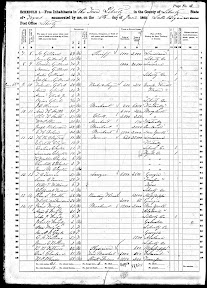
1860 Census Town of Liberty Liberty County, Texas 06 June 1860

From 1860 Census

  • James Wrigley 37 M Merchant 15,000 2000 New York
  • Ann E. Wrigley 31 F Alabama
  • Lela J. Wrigley 9 F Liberty Co.
  • John B. Wrigley 3 M Galveston
  • Ida Wrigley 1 F Liberty Co.
  • Ann P. A. Gayle 49 F Georgia
  • C. A. Bolling 27 F -- 1500 Alabama
  • James E Bolling 2 M Liberty Co
  • B. B Fathine 34 M Physician 500 Mississippi
  • Danl Cleveland 51 M Town Marshal 5000 500 Vermont
  • B. F. Rhoads 38 M Stock Driver 1550 240 Tennessee


1870 Census Liberty County, Texas 12 July 1870

  • Wrigley, James 47 M W Merchant 250 New York
  • Wrigley, Annie E. 41 F W Houskeeping 2500 Alabama
  • Wrigley, John 15 M W 50 Texas
  • Wrigley, Ida E. 11 F W Texas
  • Wrigley, Annie C. 6 F W Texas


  • Sunday May 11th 1862. Today Capt James Wrigley’s wife was delivered of a female child, slightly hair lipped. (10) I bought from Jim Rogers negro man 200 pues (11) for 7$. River still rising. weather changeable and showery.
  • Monday May 12th 1862. Today the steamer Ruthven arrived with Capt James Wrigley and Ed. Jones on board. In the evening I assisted Capt Wrigley in burying his dead infant. The boys [are] busy in the ware house. The river [is] still rising. weather changeable with occasional showers of rain.


1880 Census Liberty County, Texas Liberty Town

  • James Wrigley, 57 WM NY Eng Ma Farmer
  • Anne E. Wrigley 50 WF Al Al Ga wife (Gayle)
  • John B. Wrigley 25 WM Tx NY Al Son Oc: Depy Co Clerk
  • Annie C. Wrigley 16 WF Tx NY Al dtr at home
  • Ann J A Gayle 73 WF Ga Va Va Mother-in-law
  • 3 servants